
Last reviewed: August 26, 2026. API features and pricing change; verify current official documentation before production rollout.
OpenAI API current information does not appear automatically in every model response. Developers must choose live web search, private retrieval, or both—and preserve citations and freshness.
In this guide
Model knowledge is not a live database
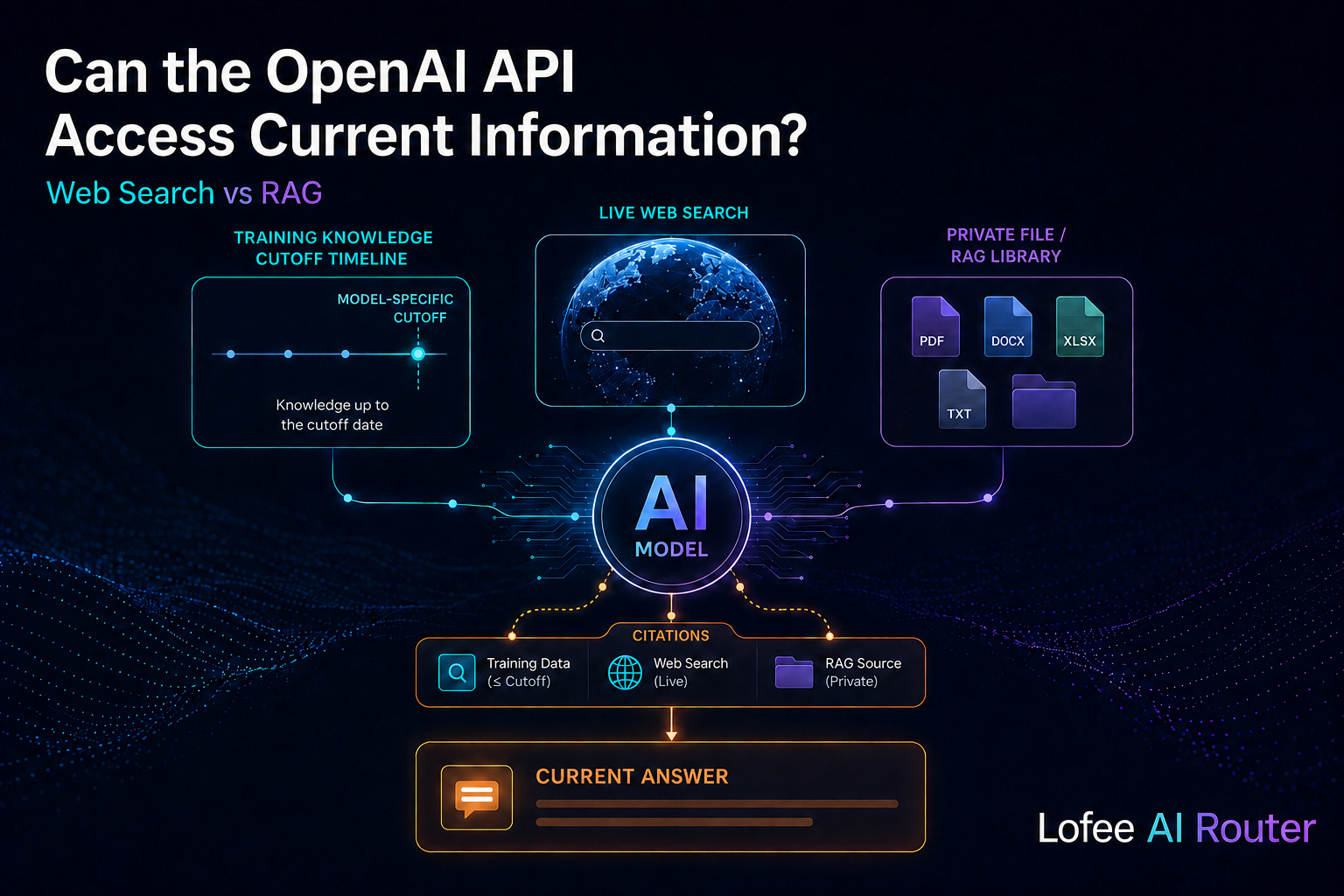
A model answers from learned parameters and the context you supply. Each model can have a different knowledge cutoff, so never hard-code one global date. If a question depends on today’s prices, laws, schedules, software versions, or news, the application needs a current source.
Option 1: Responses API web search
OpenAI’s Responses API supports a web search tool for compatible models and configurations. The model can search the public web and return source-aware results. Use it for changing public facts, then display citations clearly. Follow the official tool documentation for parameters, supported models, and source handling.
Option 2: file search and private RAG
File search and retrieval-augmented generation are better for company policies, product documentation, customer records, or curated knowledge. Index authoritative documents, attach access controls, retrieve relevant chunks, and tell the model to answer from supplied evidence. Private retrieval can be current if your ingestion pipeline is current.
Lofee AI Router
One Affordable API.
Claude, GPT, Gemini and more — through one affordable API. Use separate keys and unified usage tracking for supported model workflows.
Web search vs RAG
Web search offers broad public coverage but variable quality and availability. RAG offers control, provenance, and privacy but only knows what you indexed. Many production systems combine them: consult internal policy first, then search the web only when the request requires external freshness.
Create a freshness contract
Classify fields by maximum acceptable age. A product description might tolerate days; an incident status may require seconds. Store fetched_at, source URL, document version, and expiry. If evidence is too old, refresh it or tell the user the answer cannot be verified.
Preserve citations through the UI
A citation is useful only if the user can identify the source behind the claim. Keep source IDs attached to text spans or structured claims, render descriptive links, and avoid inventing URLs. Log the sources used for debugging, but redact sensitive private document names when appropriate.
Defend against retrieval injection
Web pages and documents can contain instructions designed to hijack the model. Treat retrieved text as untrusted data, separate it from system instructions, restrict tools, validate outputs, and require approval for consequential actions. Source relevance does not imply source safety.
Build a cleaner multi-model workflow
Keep provider configuration, application keys, and usage visibility in one operational layer while testing every compatibility-sensitive feature.
Evaluate factual freshness
Build tests with facts that change on known schedules, questions answerable only from internal documents, and conflicting sources. Score citation correctness, source authority, recency, completeness, and refusal behavior. Re-run tests when search tools, models, or indexes change.
Control latency and cost
Search and retrieval add network, indexing, and token costs. Query only when freshness is required, cache allowed results with short TTLs, trim retrieved context, and parallelize independent lookups. Show progress through streaming so users know the application is gathering evidence.
Where Lofee fits
Lofee can simplify access to supported text models through an OpenAI-compatible gateway, but OpenAI-specific web-search or file-search tool compatibility must be confirmed before routing that workload. A safe architecture keeps retrieval as an application service and treats the model route as replaceable.
OpenAI API current information: production checklist
- Keep secrets server-side and redact logs.
- Pin configuration and test changes with representative evaluations.
- Measure latency, usage, errors, and cost per successful task.
- Use bounded retries and a documented rollback path.
- Verify gateway compatibility for provider-specific features.
Frequently asked questions
No. Current facts require a live tool or fresh context; model knowledge alone has a model-specific cutoff.
Use it for changing public information when broad web coverage and citations are needed.
Use RAG for private, curated, access-controlled, or domain-specific documents.
Yes. Define precedence, access rules, citation handling, and freshness requirements.
Do not assume so. Confirm the gateway and model support the exact Responses API tool behavior you need.
Official sources
This article is technical guidance, not a guarantee of service compatibility, security certification, or current provider pricing.
Leave a Reply