
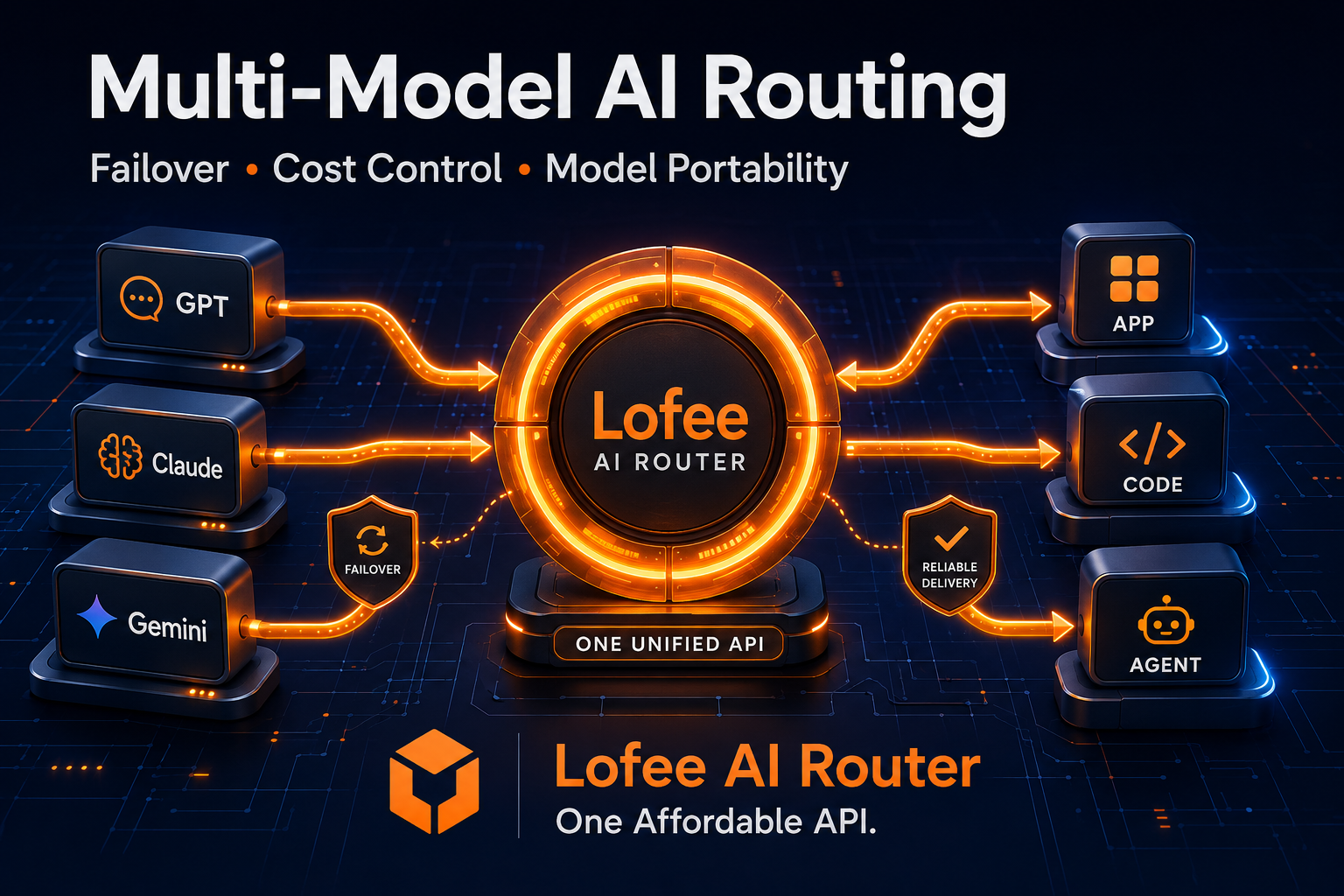
A production AI feature should not depend on one model behaving perfectly forever. Providers impose different rate limits, models change, traffic spikes, prices move, and the strongest model for coding may not be the best model for extraction or customer support.
Multi-model AI routing solves that problem by placing a policy layer between your application and the models it can use. The router decides which model should receive a request, when a temporary failure deserves a retry, when another route is an acceptable fallback, and when the safest response is to stop.
This guide shows AI developers and small teams how to design that layer for production: model selection, retry budgets, failover, cost controls, feature compatibility, observability, and a practical TypeScript implementation.
This article was checked against current OpenAI, Anthropic, and Google API documentation on August 26, 2026. Model availability, limits, SDK behavior, and pricing can change.
Quick answer: what is multi-model AI routing?
Multi-model AI routing is the practice of selecting an AI model or provider for each request according to an explicit policy. A useful production policy considers:
- task type and required capability;
- latency and availability targets;
- input and output cost;
- context length and modality;
- support for tools, streaming, and structured output;
- temporary errors and rate limits;
- quality checks and escalation rules.
The goal is not to switch models as often as possible. It is to make model choice deliberate, observable, and reversible.
| Mechanism | What it does | Typical example |
|---|---|---|
| Routing | Selects a model before the first attempt | Send classification to a fast model and complex coding to a stronger model |
| Retry | Repeats the request on the same route | Wait and retry after a temporary 429 or 503 |
| Failover | Moves equivalent traffic to another healthy route | Use a secondary upstream after the primary route is unavailable |
| Fallback | Uses a different model or reduced service level | Continue a drafting task on another model after the preferred model fails |
| Escalation | Promotes a difficult request to a stronger model or human | Send a failed extraction to a frontier model for repair |
Lofee AI Router
One Affordable API.
Claude, GPT, Gemini and more — through one affordable API. Use one pay-as-you-go account, create separate keys for apps or team members, and review supported routes without maintaining a separate balance everywhere.
Why a single-model architecture becomes technical debt
A single model is a reasonable way to ship an MVP. It becomes risky when the model slug, API key, prompt format, and error handling are scattered throughout the product. At that point, a provider incident or model migration becomes an application-wide change.
The most common failure modes are predictable:
- Rate limits: traffic can exceed requests-per-minute or tokens-per-minute limits even when monthly budget remains.
- Temporary overload: Anthropic documents a 529
overloaded_error, while Google documents retryable 503UNAVAILABLEresponses. - Provider-specific limits: models and usage tiers can have different throughput ceilings and shared capacity.
- Model lifecycle changes: aliases, snapshots, supported features, and deprecation dates change over time.
- Cost mismatch: a flagship model used for every classification or rewrite can waste budget.
- Capability mismatch: a cheap route may accept the request but fail the schema, tool-use, or quality requirement.
A routing layer does not eliminate these problems. It gives the team one place to express and update the response to them.
Start with workload tiers, not provider names
Provider-first policies age badly. Instead of writing “all requests use Model X,” define workload tiers and map currently approved models to them.
| Workload tier | Examples | Routing goal | Fallback posture |
|---|---|---|---|
| Fast and narrow | Tagging, intent detection, short rewrites | Low cost and low latency with strict validation | Retry briefly, then use another validated fast model |
| Balanced production | Support answers, summaries, normal tool use | Reliable quality at sustainable cost | Allow a disclosed equivalent fallback |
| Complex reasoning | Repository changes, analysis, long-horizon agents | Minimize task failure and human rework | Retry, then use another high-capability route or pause |
| Model-specific evaluation | Benchmarks, regression tests, vendor comparison | Preserve exact model identity | Do not fall back; fail the run |
| Audited or high-risk | Regulated decisions, security-sensitive workflows | Traceability and policy compliance | Require an approved route and explicit evidence |
This separation makes model replacement much easier. The product depends on a workload contract; the routing configuration decides which models currently satisfy it.
If you need a starting shortlist for OpenAI and Claude workloads, see our comparison of GPT-5.6 Sol, Terra, and Luna vs Claude.
The five-layer routing architecture
1. Classify the request
Use product context before using another model as a classifier. The endpoint, feature, customer tier, input size, requested tools, and latency budget often reveal the correct route without an extra AI call.
support_tagging     -> fast-and-narrow
support_draft       -> balanced-production
repository_agent    -> complex-reasoning
benchmark_run       -> exact-model-required
regulated_summary   -> approved-routes-only
Add an AI classifier only when the request itself contains ambiguity worth paying to resolve.
2. Filter routes by hard capabilities
Before comparing price or quality, remove routes that cannot satisfy the request. Check the exact model and route for:
- context-window and output limits;
- image, audio, or file input;
- tool or function calling;
- streaming behavior;
- structured output or JSON Schema support;
- reasoning controls;
- regional, policy, or data-handling requirements.
An OpenAI-compatible interface simplifies common request plumbing, but compatibility is not feature equivalence. Advanced parameters can behave differently across models and routes. Validate the capabilities your product actually uses.
3. Rank the eligible candidates
Rank only the routes that passed the hard filters. A basic score can combine quality, price, recent latency, and recent error rate:
route_score =
  quality_weight * evaluated_quality
  - cost_weight * estimated_request_cost
  - latency_weight * recent_p95_latency
  - reliability_weight * recent_error_rate
Keep the formula understandable. A small team usually benefits more from three explicit routing rules than from a complex optimizer nobody can debug.
4. Execute with a bounded retry budget
Retry transient failures before switching models. OpenAI, Anthropic, and Google all document exponential backoff for temporary rate-limit or server errors. Their official SDKs also perform some retries automatically, so an application must avoid accidentally stacking an aggressive outer retry loop on top.
A safe retry policy usually includes:
- a maximum attempt count;
- a maximum total retry time;
- respect for
Retry-Afterwhen present; - exponential delay with random jitter;
- a distinction between temporary rate limiting and billing or spend-cap errors;
- no blind retry for malformed requests or invalid credentials.
5. Validate the result before accepting it
A successful HTTP response is not necessarily a successful product outcome. Validate JSON, required fields, tool arguments, citations, safety rules, or code tests before returning the result.
For extraction and other machine-consumed responses, combine routing with the techniques in our guide to consistent structured API output.
Which errors should trigger retry or failover?
| Signal | Typical meaning | Recommended action |
|---|---|---|
| 400 | Invalid request or unsupported parameter | Stop and fix the request; do not hide it with failover |
| 401 | Invalid or missing credentials | Stop, alert, and rotate or correct the key |
| 403 | Permission, region, or policy restriction | Stop unless another route is explicitly approved for this workload |
| 404 | Wrong endpoint, model, or resource | Check configuration or model lifecycle; do not repeatedly retry |
| 408 / network timeout | Temporary transport failure | Retry within budget; protect side effects with operation IDs |
| 429 with Retry-After | Temporary rate limiting | Wait at least as instructed, add jitter, then retry |
| 429 without temporary-limit evidence | May be quota, billing, spend cap, or acceleration limit | Inspect the provider error before deciding to retry or fail over |
| 500 / 502 / 503 / 504 | Temporary provider or network failure | Retry briefly, then use an approved fallback or open the circuit |
| Anthropic 529 | API temporarily overloaded | Use backoff, then fail over if the workload permits |
| Safety refusal | Provider or application policy decision | Do not route around safeguards; clarify legitimate intent or stop |
Error codes alone are not enough. OpenAI notes that not every 429 is solved by retrying. Anthropic likewise distinguishes temporary rate limiting from spend-cap conditions that continue until access resumes. Preserve the structured error type, message, headers, and request ID.
Use a circuit breaker to stop retry storms
If a route has failed repeatedly, continuing to send it every new request wastes latency and can amplify an outage. A circuit breaker gives the route three states:
- Closed: requests flow normally.
- Open: the route is temporarily skipped after enough recent failures.
- Half-open: a small number of probe requests test whether the route recovered.
Track circuit state per route and workload, not only per provider. One model or region can be unhealthy while another remains usable. Use a rolling window and a cooldown rather than permanently disabling a route after one incident.
A practical TypeScript routing example
The following simplified pattern separates policy from provider adapters. Each adapter translates the normalized request into the exact OpenAI-compatible, Claude-compatible, or other provider format it supports.
type NormalizedRequest = {
  workload: "fast" | "balanced" | "complex";
  prompt: string;
  needsTools?: boolean;
  needsJsonSchema?: boolean;
  operationId: string;
};

type Route = {
  id: string;
  model: string;
  capabilities: Set<string>;
  call: (request: NormalizedRequest) => Promise<unknown>;
};

const temporaryStatuses = new Set([408, 429, 500, 502, 503, 504, 529]);

function isEligible(route: Route, request: NormalizedRequest) {
  if (request.needsTools && !route.capabilities.has("tools")) return false;
  if (request.needsJsonSchema && !route.capabilities.has("json_schema")) return false;
  return true;
}

async function callWithPolicy(request: NormalizedRequest, candidates: Route[]) {
  const eligible = candidates.filter((route) => isEligible(route, request));

  for (const route of eligible) {
    for (let attempt = 0; attempt < 2; attempt++) {
      try {
        const result = await route.call(request);
        return validateForWorkload(result, request.workload);
      } catch (error: any) {
        const status = Number(error?.status);
        const retryable = temporaryStatuses.has(status) && error?.temporary !== false;

        logAttempt({
          operationId: request.operationId,
          routeId: route.id,
          model: route.model,
          attempt,
          status,
          requestId: error?.requestId,
        });

        if (!retryable) throw error;
        if (attempt === 0) await backoffWithJitter(error?.retryAfter);
      }
    }
  }

  throw new Error("No approved route completed the request");
}
Production code needs stronger types, timeouts, circuit state, cancellation, stream handling, cost accounting, and provider-specific error normalization. The important architectural choice is that feature code calls a routing contract instead of importing a provider SDK everywhere.
Do not fail over side effects without idempotency
Agent workflows are harder than simple text generation because a model can call tools. A timeout does not prove that nothing happened. The upstream response may have been lost after a tool already sent an email, changed a database record, created a ticket, or submitted a transaction.
Before retrying or failing over an agent step:
- assign a unique
operation_idto the intended action; - make tools reject duplicate operation IDs;
- separate planning from execution where practical;
- store tool results before requesting the next model turn;
- require confirmation for irreversible or high-value actions;
- resume from persisted state rather than replaying the entire agent run.
“At least once” execution without deduplication is not safe for side-effectful agents.
Design fallback semantics explicitly
A fallback is a product decision, not merely an infrastructure decision. Decide what the user should experience when the preferred route is unavailable.
| Fallback mode | Behavior | Good fit |
|---|---|---|
| Equivalent fallback | Use another model that passed the same acceptance tests | Support drafting, summaries, normal assistants |
| Degraded fallback | Disable tools, shorten output, or use a faster lower-cost model | Non-critical features with a clear user notice |
| Queue and resume | Store the job and retry later | Batch processing, reports, long-running generation |
| Escalate | Use a stronger model or human review | Failed validation and high-value tasks |
| Fail closed | Stop instead of substituting another model | Benchmarks, audited flows, model-specific promises |
Never tell a user that a particular model completed the task if another model produced the response. If model identity matters, expose it in the interface or preserve it in an audit record.
Keep the access layer simpler while your routing policy evolves.
Lofee provides supported GPT, Claude, Gemini, Grok, and other model routes through one pay-as-you-go account. Create dedicated keys for individual applications or team members, then use the usage view to see which workloads consume the budget. Exact model and route capabilities should always be confirmed in the current Model Plaza.
Measure expected cost, not only token price
The cheapest model on a pricing page can be the most expensive model in a product if it fails validation, produces longer outputs, or sends many cases to human review.
expected_cost =
  primary_model_cost
  + probability_of_retry * retry_cost
  + probability_of_fallback * fallback_cost
  + probability_of_human_review * review_cost
Measure at least:
- successful tasks per dollar;
- p50 and p95 end-to-end latency;
- schema or test pass rate;
- retry and fallback rate;
- input and output tokens by workload;
- human review minutes;
- customer-visible failure rate.
Use separate application keys when possible. If background extraction, a coding agent, and customer chat all share one key, cost anomalies and rate-limit pressure become harder to trace.
What to log for every routed request
operation_id
application_key_id
workload_class
requested_model_or_tier
resolved_model
route_or_upstream_id
attempt_number
fallback_reason
provider_request_id
http_status_and_error_type
latency_ms
input_tokens
output_tokens
estimated_cost
validation_result
OpenAI exposes rate-limit information in response headers. Anthropic includes a unique request ID in responses and error bodies. Preserve those identifiers: they make incident investigation and provider support much faster.
How to evaluate routes before production
- Collect representative tasks. Use real, anonymized examples from each product feature.
- Define acceptance criteria. Tests, schemas, rubric scores, tool success, or human approval must be established before comparison.
- Run every candidate on the same set. Record reasoning settings, prompts, tools, model versions, latency, and token use.
- Choose a default and fallback separately. The second-best average model may not be the safest fallback if it lacks a required feature.
- Test failure injection. Simulate 429, timeout, 503, malformed output, and mid-stream interruption.
- Re-run after model or prompt changes. Routing decisions expire when the underlying behavior changes.
Start with a small, understandable policy. Add dynamic health and cost signals only after you have reliable logs and a stable evaluation set.
Common multi-model routing mistakes
Failing over on every error
A 401 or malformed request will not become correct because it was sent to another model. Normalize errors and classify them before deciding.
Treating all 429 errors as temporary
A 429 can indicate a short-lived rate limit, but it can also reflect a spend cap, quota, or billing condition. Inspect the error and headers.
Assuming compatible APIs are identical
Common SDK syntax does not guarantee identical support for tools, reasoning settings, JSON Schema, streaming events, images, or token accounting.
Using a fallback that was never evaluated
A model is not an equivalent fallback merely because it can produce text. It must meet the same acceptance criteria for that workload.
Hiding the resolved model
Without requested and resolved model fields, teams cannot explain quality changes, route incidents, or benchmark contamination.
Routing around safety controls
Fallback is for availability and product continuity, not for evading provider or application safeguards.
FAQ
Multi-model AI routing is a policy layer that selects an AI model or provider for each request based on workload, capabilities, cost, latency, availability, and quality requirements. It also defines retries, fallbacks, and escalation.
Routing chooses a model before the first attempt. Failover moves a request to another approved route after the primary route becomes unavailable. A retry repeats the request on the same route.
No. Retry a temporary rate-limit error according to Retry-After or exponential backoff, but first distinguish it from quota, billing, spend-cap, or other conditions that require action rather than another request.
A unified AI API gateway can provide access to supported model routes under one account. Use separate application keys for different products or teams when possible so usage, limits, troubleshooting, and key rotation remain clear.
Start with workload-based rules: a validated fast model for narrow tasks, a balanced model for normal production traffic, and a stronger model for complex or failed cases. Add bounded retries, explicit fallback rules, separate keys, and request-level logging before using dynamic optimization.
Final recommendation
For most small AI teams, the right first version of multi-model AI routing is simple:
- define three workload tiers;
- approve one primary and one tested fallback for each tier;
- retry only temporary failures with a strict time budget;
- validate every machine-consumed result;
- log the requested model, resolved model, route, cost, and fallback reason;
- fail closed when model identity, policy, or auditability matters.
This architecture gives a startup model portability without pretending all models are interchangeable. It also creates the data needed to improve cost and reliability later.
Leave a Reply