
Last reviewed: August 26, 2026. API features and pricing change; verify current official documentation before production rollout.
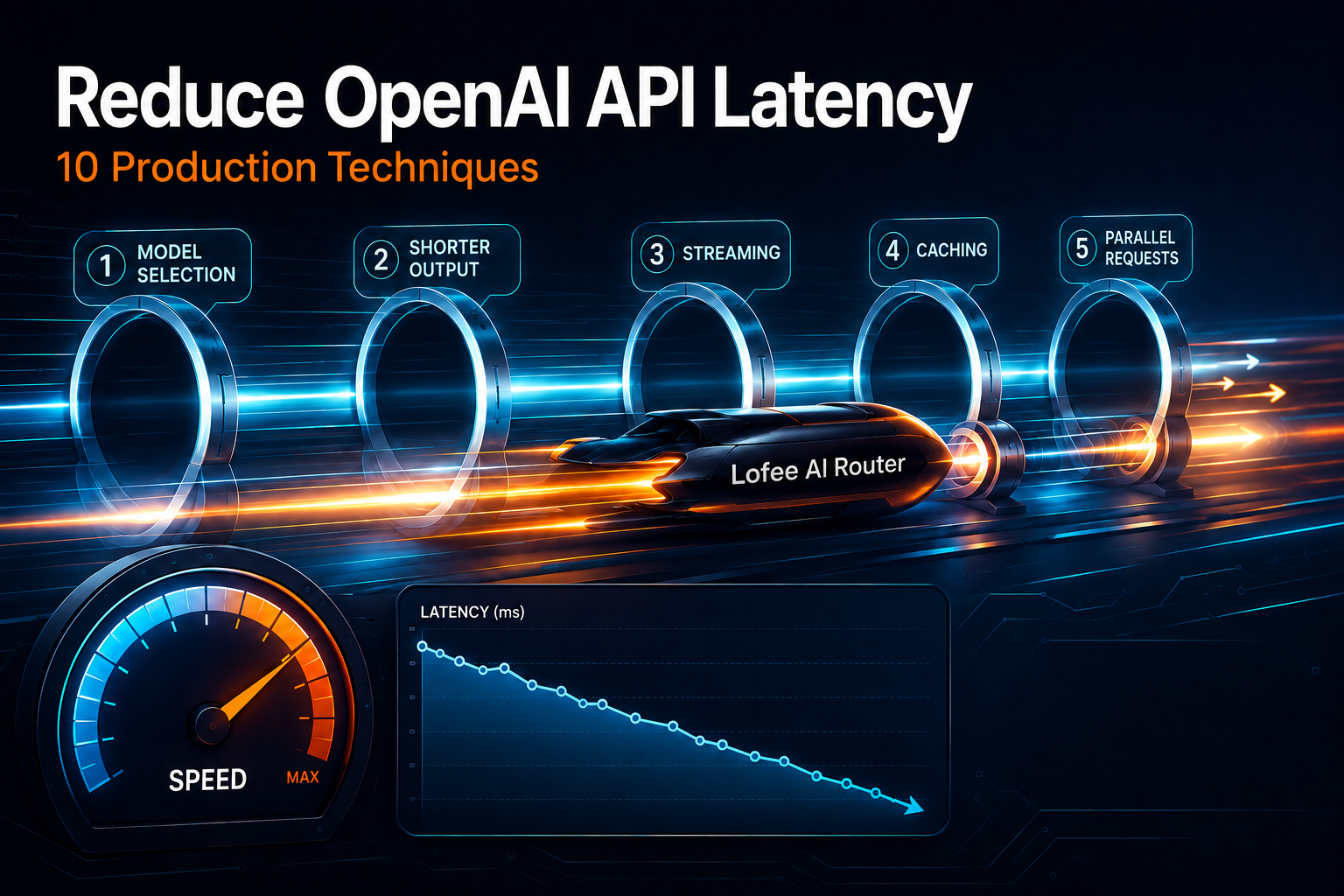
To reduce OpenAI API latency, optimize the critical path: model choice, generated tokens, streaming, parallel work, connection reuse, caching, and production measurement.
In this guide
- Measure the right latency milestones
- 1. Choose the fastest model that passes evals
- 2. Generate fewer output tokens
- 3. Stream user-facing responses
- 4. Parallelize independent work
- 5. Remove unnecessary model calls
- 6. Reuse connections and clients
- 7. Cache stable inputs and outputs
- 8. Set timeouts, backoff, and retry budgets
- 9. Optimize retrieval and tools
- 10. Use routing with observability
Measure the right latency milestones
Record DNS, connect, TLS, time to first byte, time to first token, and total completion time. A single average hides cold starts and tail failures; track p50, p95, and p99 by model, region, route, and response length. OpenAI recommends measuring the actual application because model and generated token count are major latency drivers.
1. Choose the fastest model that passes evals
Larger reasoning-capable models often trade speed for capability. Build a small evaluation set for your task, then choose the smallest model that satisfies quality, safety, and tool-use requirements. Route only difficult requests to a stronger model. This is more reliable than assuming every user turn deserves the most capable option.
2. Generate fewer output tokens
Generation is sequential, so long answers usually dominate end-to-end time. Ask for concise output, set a realistic maximum, use schemas that omit unused prose, and stop once the task is complete. OpenAI’s latency guide explicitly highlights output length as a major lever. Shorter responses also reduce cost.
Lofee AI Router
One Affordable API.
Claude, GPT, Gemini and more — through one affordable API. Use separate keys and unified usage tracking for supported model workflows.
3. Stream user-facing responses
Streaming does not necessarily make the model finish sooner, but it dramatically improves perceived latency by delivering text or events as they arrive. Design the UI for partial content, cancellation, and error recovery. Never expose raw tool arguments or unvalidated structured fragments before they are safe to display.
4. Parallelize independent work
If moderation, retrieval, profile lookup, and classification do not depend on one another, start them together. Use a deadline and cancel work that is no longer needed. Do not parallelize dependent model turns merely to look fast; speculative calls can multiply cost and create inconsistent state.
5. Remove unnecessary model calls
Rules, regular expressions, database filters, and deterministic templates can handle many routing and formatting steps. Combine adjacent transformations in one request when it does not harm reliability. Every round trip adds queueing, network, and model latency. Keep the model on tasks that genuinely need semantic judgment.
6. Reuse connections and clients
Create the SDK client once per process, use HTTP keep-alive, reuse TLS connections, and avoid rebuilding agents for every request. Place compute in a sensible region and measure network segments independently. A gateway adds a hop, so evaluate total user-perceived latency and routing benefits rather than assuming either direct or relayed traffic is always faster.
Build a cleaner multi-model workflow
Keep provider configuration, application keys, and usage visibility in one operational layer while testing every compatibility-sensitive feature.
7. Cache stable inputs and outputs
Cache deterministic results, retrieval documents, embeddings, authorization decisions, and frequently repeated prompts where privacy rules allow. Use explicit keys, tenant boundaries, TTLs, and model-version information. Prompt caching features can reduce repeated processing, but application caching is still valuable for exact repeat workloads.
8. Set timeouts, backoff, and retry budgets
Use separate connect and total deadlines. Retry only transient errors with exponential backoff and jitter, honor Retry-After, and cap attempts inside the user’s latency budget. Hedged requests can reduce tail latency but increase cost and duplicate side effects; reserve them for idempotent, high-value paths.
9. Optimize retrieval and tools
Limit retrieved context to relevant chunks, run tool calls close to their data, and return compact machine-readable results. A huge prompt can slow preprocessing and distract the model. Trace each tool span so the team can see whether latency comes from the model, vector store, database, or external API.
10. Use routing with observability
Lofee can give small teams one OpenAI-compatible integration across multiple supported models, separate keys, and unified usage inspection. That can simplify evaluated model routing and fallback experiments. Measure each route with the same payload and avoid promising latency improvements until your own p95 data proves them.
reduce OpenAI API latency: production checklist
- Keep secrets server-side and redact logs.
- Pin configuration and test changes with representative evaluations.
- Measure latency, usage, errors, and cost per successful task.
- Use bounded retries and a documented rollback path.
- Verify gateway compatibility for provider-specific features.
Frequently asked questions
Reduce generated output length and select the smallest model that passes your evaluations.
It mainly reduces perceived latency by showing output before completion; total generation time may be similar.
Only within a bounded deadline and for transient failures. Retrying every slow request can increase load and tail latency.
No. It adds a network hop, but routing and operational benefits may outweigh it. Measure p95 end to end.
Replay representative prompts, hold parameters constant, warm connections, and compare quality plus p50, p95, errors, and cost.
Official sources
This article is technical guidance, not a guarantee of service compatibility, security certification, or current provider pricing.
Leave a Reply