
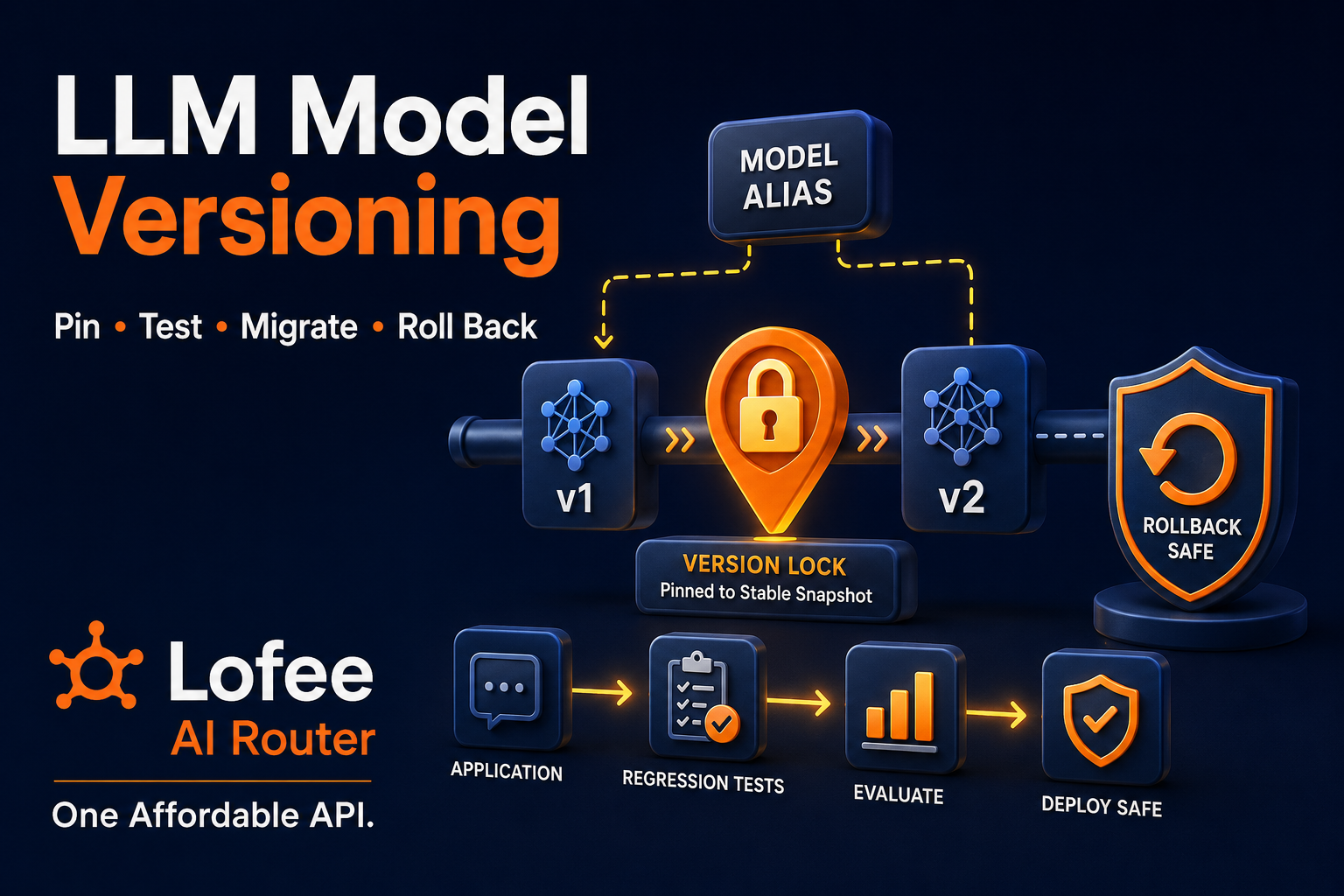
An AI application can break even when its API request still returns 200. A provider may update a floating model alias, change default behavior, deprecate an endpoint, or retire a snapshot. The result can be quieter than a normal outage: extraction accuracy drifts, tool arguments change, safety behavior moves, or outputs become longer and more expensive.
LLM model versioning turns those changes into controlled releases. The core practice is to pin what can be pinned, record what actually served each request, evaluate new versions against a stable contract, and keep a tested rollback path.
This guide was reviewed against current OpenAI, Anthropic, and Google model-lifecycle documentation on August 26, 2026. Always confirm the dates and identifiers for the exact API you use.
LLM model versioning: how to prevent silent updates
- Use a dated snapshot or stable model ID when the provider offers one.
- Keep model IDs in centralized route configuration.
- Log the requested and resolved model for every request.
- Run contract and quality evaluations before changing versions.
- Canary the new version on a small traffic slice.
- Compare quality, latency, errors, and cost against the old version.
- Retain a rollback route until the canary is accepted.
| Identifier type | Typical behavior | Production use |
|---|---|---|
| Floating alias | May move to a newer snapshot | Useful for exploration; risky without continuous evals |
| Dated snapshot | Locks a specific published model version | Best for reproducibility when available |
| Stable model | Intended for production with provider lifecycle policy | Good default, but still monitor deprecations |
| Preview model | Features and availability may change faster | Use behind flags, caps, and rollback |
| Internal route alias | Your application maps a business tier to an approved model | Separates product code from provider IDs |
Lofee AI Router
One Affordable API.
Claude, GPT, Gemini and more — through one affordable API. Keep model selection in configuration, test alternative routes, and use separate keys for production and version canaries.
Why model drift is an API breaking change
A traditional API contract describes fields and status codes. An LLM contract also includes probabilistic behavior:
- schema-valid response rate;
- tool-selection and argument accuracy;
- instruction priority and refusal behavior;
- reasoning effort and output length;
- latency, throughput, and rate-limit pressure;
- tokenization and billed usage;
- supported modalities and context limits.
A new model can improve aggregate benchmarks while regressing a narrow workflow. That is why a release note cannot replace your own acceptance suite.
Provider lifecycle patterns
OpenAI model pages distinguish aliases from snapshots and state that snapshots can lock a specific version so performance and behavior remain consistent. Anthropic publishes Active, Legacy, Deprecated, and Retired lifecycle stages and says public models receive at least 60 days’ notice before retirement. Google distinguishes stable and preview model naming.
These policies are useful inputs, not substitutes for monitoring. Cloud partners can have different schedules, preview routes can change faster, and a snapshot still depends on the surrounding API, tools, prompts, and your own data.
Create an internal model registry
Product code should request a workload tier rather than a provider model string:
model_routes:
  support_draft:
    primary: provider/model-snapshot-a
    fallback: provider-b/model-snapshot-c
    prompt_version: support-v12
    eval_suite: support-contract-v7
  code_agent:
    primary: provider/model-snapshot-b
    fallback: provider-c/model-snapshot-d
    prompt_version: code-agent-v4
    eval_suite: repository-agent-v5
Store owner, approval date, context limit, modalities, tool support, data classification, price assumptions, and retirement date with every entry. Make route changes reviewable like code.
Build a regression contract
| Test layer | Example | Failure rule |
|---|---|---|
| Protocol | Streaming events parse; usage fields exist | Zero tolerance |
| Schema | Required JSON fields and types | Below agreed pass rate blocks release |
| Tools | Correct tool and valid arguments | No unsafe side effect may pass |
| Task quality | Rubric or hidden test score | Non-inferiority threshold |
| Safety | Prompt injection and policy cases | Critical regression blocks release |
| Operations | p95 latency, output tokens, error rate | Must fit product SLO and budget |
Use representative, anonymized production examples. Keep the evaluation set versioned and prevent prompt authors from tuning only to visible tests.
Canary without contaminating users
- Shadow first. Send a copy of eligible, redacted requests to the candidate model when policy permits, but return the current model’s answer.
- Review differences. Compare validation, rubric, latency, tokens, and safety outcomes.
- Start a small canary. Route a stable cohort rather than randomly switching every conversation turn.
- Hold model identity. Keep one conversation on one evaluated model unless a disclosed failover policy applies.
- Expand gradually. Stop automatically when a guardrail crosses its limit.
For an implementation of workload routes and fallbacks, see multi-model AI routing for agents.
Log enough to reproduce a result
operation_id
requested_route
requested_model
resolved_model
provider_or_gateway_route
prompt_version
tool_schema_version
retrieval_index_version
model_parameters
request_id
input_tokens
output_tokens
latency_ms
validation_result
If the provider does not return a resolved snapshot for a floating alias, record that limitation and the request timestamp. Exact reproduction may be impossible, which is another reason to pin snapshots for audited flows.
Design the rollback before the upgrade
A rollback is more than changing one string. Confirm that the old route is still available, its prompt remains compatible, its tool schemas are retained, and the application can resume or restart in-flight work safely.
| Trigger | Immediate action |
|---|---|
| Schema pass rate drops | Stop canary and restore prior route |
| Unsafe tool behavior | Disable affected tools, preserve evidence, roll back |
| Cost per task exceeds cap | Reduce traffic and inspect output or retry growth |
| Provider retires old snapshot | Use the pre-approved alternate route, not an untested alias |
| Conversation incompatibility | Keep existing sessions pinned; use new model only for new sessions |
Handle deprecation as planned maintenance
Subscribe to provider release and deprecation notices. Put retirement dates into the engineering calendar, open migration work early, and assign an owner. A simple policy is:
notice received   -> inventory within 2 business days
candidate chosen  -> offline eval within 2 weeks
canary complete   -> before half the notice window passes
old route removed -> only after rollback and archives are updated
Do not rely on a provider to keep a deprecated model alive because traffic still exists. Anthropic documents that requests to retired models fail.
Separate your product contract from provider model names.
Lofee offers supported GPT, Claude, Gemini, Grok, and other routes through one pay-as-you-go account. Keep route choice centralized, create a dedicated canary key, and verify the exact current model in the Model Plaza before release.
Common versioning mistakes
- Using
latesteverywhere and discovering drift through customer reports. - Pinning the model but not the prompt, tools, retrieval index, or parameters.
- Testing only average quality and missing a critical minority workflow.
- Mixing models inside a conversation without recording or disclosing the change.
- Removing the old route before the canary has stable production evidence.
- Assuming a snapshot is supported forever.
FAQ
LLM model versioning is the practice of controlling, recording, testing, and releasing model changes. It includes pinned snapshots, route configuration, regression evaluations, canaries, deprecation tracking, and rollback.
Pin a tested snapshot when reproducibility matters and the provider offers one. Continue to track lifecycle notices because snapshots can still be deprecated or retired.
A floating alias may resolve to a newer model behavior without an application deployment. Continuous evaluations and resolved-model logging are needed if you use one in production.
Run protocol, schema, tool, quality, safety, latency, and cost checks on representative tasks. Then shadow or canary a stable traffic cohort with automatic rollback limits.
Log the requested route, requested and resolved model, provider route, prompt and tool versions, request ID, parameters, token usage, latency, and validation result, subject to your data policy.
Final recommendation
Treat every model change like a dependency upgrade with probabilistic tests. Pin the version when possible, centralize routes, canary against an explicit contract, and keep the previous approved route until production evidence is stable. That turns silent drift into an observable release decision.
Leave a Reply